Why Small Business Tax Planning Is Essential in 2026
Small business owners have a distinct tax situation that is both challenging and full of opportunities. With self-employment taxes, quarterly estimated payments, and over 50 tax deductions available, tax planning can help you save thousands — or even tens of thousands — of dollars each year. This ultimate guide includes all the key tax planning strategies for small businesses in 2026.
💡 Average Tax Savings:
Small business owners who take proactive steps to use tax planning strategies save an average of $8,400 per year, according to the NFIB. Business owners who work with tax professionals save even more, averaging $12,600 per year.
Top 20 Small Business Tax Deductions for 2026
These tax deductions will help you save a significant amount of taxable business income. The trick is to document everything and know what qualifies.
🏠 1. Home Office Deduction Save $3,000–$12,000/yr
Requirement: Exclusively and regularly used for business
Two Ways to Claim:
- Simplified Method: $5 per sq ft (max 300 sq ft = $1,500)
- Actual Expense Method: Deduct a % of mortgage/rent, property taxes, utilities, insurance, repairs, and depreciation
🚗 2. Vehicle Expenses Save $5,000–$15,000/yr
Two Methods:
- Standard Mileage Rate (2026): $0.70 per business mile
- Actual Expense Method: Gas, insurance, maintenance, depreciation × business use %
📋 Additional Top Deductions at a Glance
| Deduction | What's Included | Typical Savings |
|---|---|---|
| Office Supplies | Paper, pens, computers, software | $500–$3,000 |
| Business Meals | 50% of client/employee meals | $1,000–$5,000 |
| Travel Expenses | Flights, hotels, rental cars | $2,000–$10,000 |
| Professional Services | Accountant, lawyer, consultant fees | $2,000–$8,000 |
| Advertising & Marketing | Ads, website, social media | $1,500–$12,000 |
| Business Insurance | Liability, property, workers comp | $1,200–$6,000 |
| Phone & Internet | Business use percentage | $800–$2,400 |
| Bank Fees | Business account fees, merchant fees | $300–$1,500 |
| Employee Wages | Salaries, bonuses, benefits | Varies |
| Rent | Office, warehouse, retail space | $6,000–$36,000 |
| Utilities | Electric, gas, water, trash | $1,200–$4,800 |
| Licenses & Permits | Business licenses, professional certs | $200–$2,000 |
| Education & Training | Courses, conferences, books | $500–$5,000 |
| Software & Subscriptions | Business tools, cloud services | $600–$6,000 |
| Repairs & Maintenance | Equipment, property repairs | $800–$5,000 |
| Bad Debts | Uncollectible receivables | $500–$10,000 |
| Contract Labor | Independent contractors, freelancers | Varies |
| Depreciation | Equipment, vehicles, property | $2,000–$20,000 |
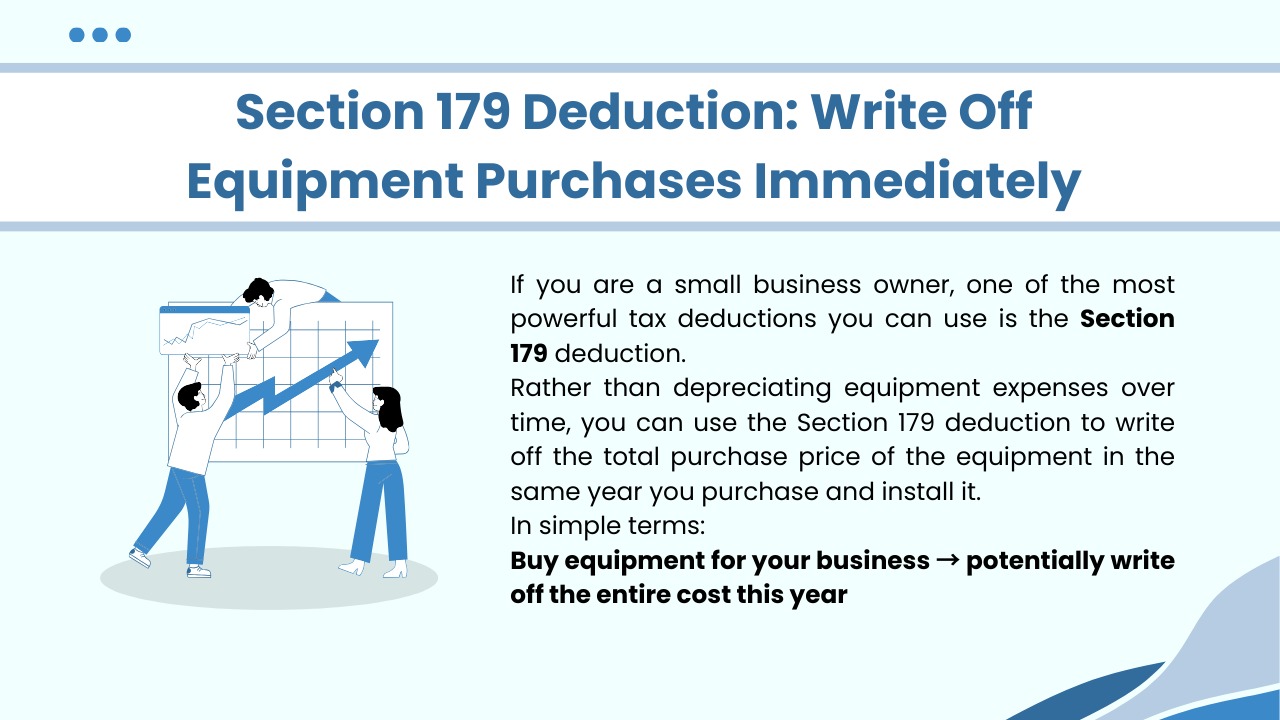
Section 179 Deduction: Write Off Equipment Immediately
If you are a small business owner, one of the most powerful tax deductions you can use is the Section 179 deduction. Rather than depreciating equipment expenses over time, you can write off the total purchase price in the same year you purchase and install it.
⚠️ Important Limits (2026)
- An annual deduction limit (adjusted for inflation each year)
- A total equipment purchase phase-out threshold
- You cannot deduct more than your business income
🏗️ Real-World Example: Daniel – Construction Business Owner
Daniel's Equipment Purchases
- $80,000 excavator
- $10,000 tools
- $5,000 business laptop & software
- Total equipment purchases: $95,000
- Business profit before deductions: $200,000
He elects Section 179 and deducts the full $95,000:
$200,000 – $95,000 = $105,000 new taxable income
📊 Section 179 vs. Bonus Depreciation
| Feature | Section 179 | Bonus Depreciation |
|---|---|---|
| Control | You choose how much to deduct | Automatic unless opted out |
| Business Income Limit | Limited by business profit | Can create a loss |
| Cap | Annual deduction cap | Percentage-based |
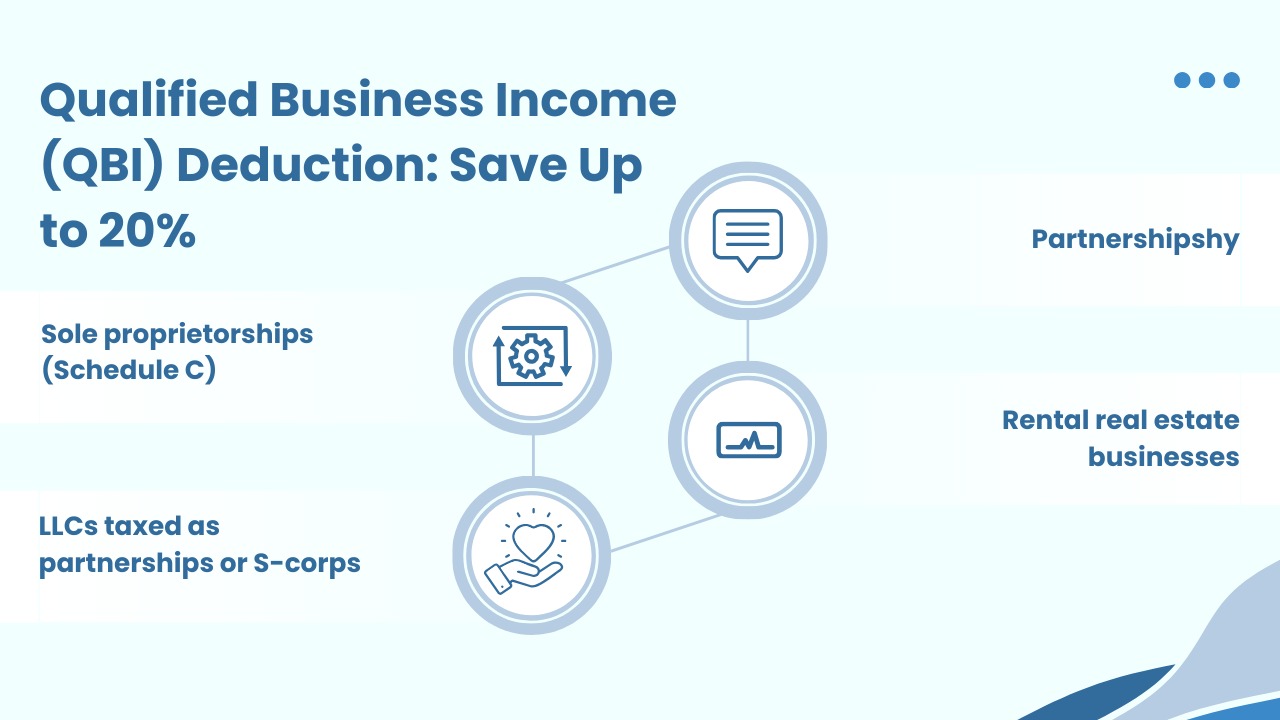
Qualified Business Income (QBI) Deduction: Save Up to 20%
One of the most valuable tax breaks available to small business owners is the QBI deduction. If you qualify, you may be able to deduct up to 20% of your business profit — simply for being a pass-through business owner.
- That's not a credit.
- That's not a loophole.
- It's written directly into tax law. And for many entrepreneurs, it means thousands in annual savings.
📊 How the QBI Deduction Works (2026)
| Filing Status | 2026 Income Threshold | Phase-Out Complete | Deduction Available |
|---|---|---|---|
| Single | Below $191,950 | $241,950 | Full 20% |
| Married Filing Jointly | Below $383,900 | $483,900 | Full 20% |
⚠️ SSTB Limitations
If you're in health, law, accounting, consulting, financial services, or performing arts, the deduction phases out above the income thresholds:
- Below threshold: Full 20% deduction
- Within phase-out range: Partial deduction
- Above phase-out: No deduction (unless you have W-2 wages/property)
Self-Employed Health Insurance Deduction
If you're self-employed and pay for your own health insurance, you can deduct 100% of premiums for yourself, your spouse, and your dependents — even if you don't itemize!
✅ What's Deductible?
- Medical insurance premiums
- Dental insurance premiums
- Long-term care insurance (subject to age-based limits)
- Medicare premiums (Part B, Part D, Medicare Advantage)
- You must have a net profit from self-employment
- Cannot deduct more than your net profit
- Cannot deduct if eligible for an employer plan (yours or spouse's)
- Deduction taken on Form 1040, Schedule 1 (not Schedule C)
Small Business Retirement Plans: Save Taxes While Building Wealth
Offering a retirement plan not only helps you save for the future but also provides immediate tax deductions.
| Plan Type | Max Contribution | Best For | Complexity |
|---|---|---|---|
| SEP IRA | Up to $69,000 (25% of comp) | Solo business, simple setup | Very Low |
| Solo 401(k) | Up to $76,500 (age 50+) | High earners, no employees | Low–Moderate |
| SIMPLE IRA | $19,500 (employee + match) | 1–100 employees | Low |
| Traditional 401(k) | $23,500 + employer match | Multiple employees | High |
| Defined Benefit | $275,000+ (age-dependent) | High income, older owners | Very High |
Estimated Quarterly Tax Payments: Avoid Penalties
As a small business owner, you're required to pay estimated taxes quarterly if you expect to owe $1,000 or more. Meeting these deadlines is crucial to avoid penalties.
📅 2026 Quarterly Tax Deadlines
| Quarter | Income Period | Due Date | % of Annual Tax |
|---|---|---|---|
| Q1 2026 | Jan 1 – Mar 31 | April 15, 2026 | 25% |
| Q2 2026 | Apr 1 – May 31 | June 16, 2026 | 25% |
| Q3 2026 | Jun 1 – Aug 31 | September 15, 2026 | 25% |
| Q4 2026 | Sep 1 – Dec 31 | January 15, 2027 | 25% |
How Much to Pay?
To avoid penalties, pay the LESSER of:
- 190% of current year tax (2026), or
- 2100% of prior year tax (110% if AGI > $150,000)
Advanced Small Business Tax Strategies
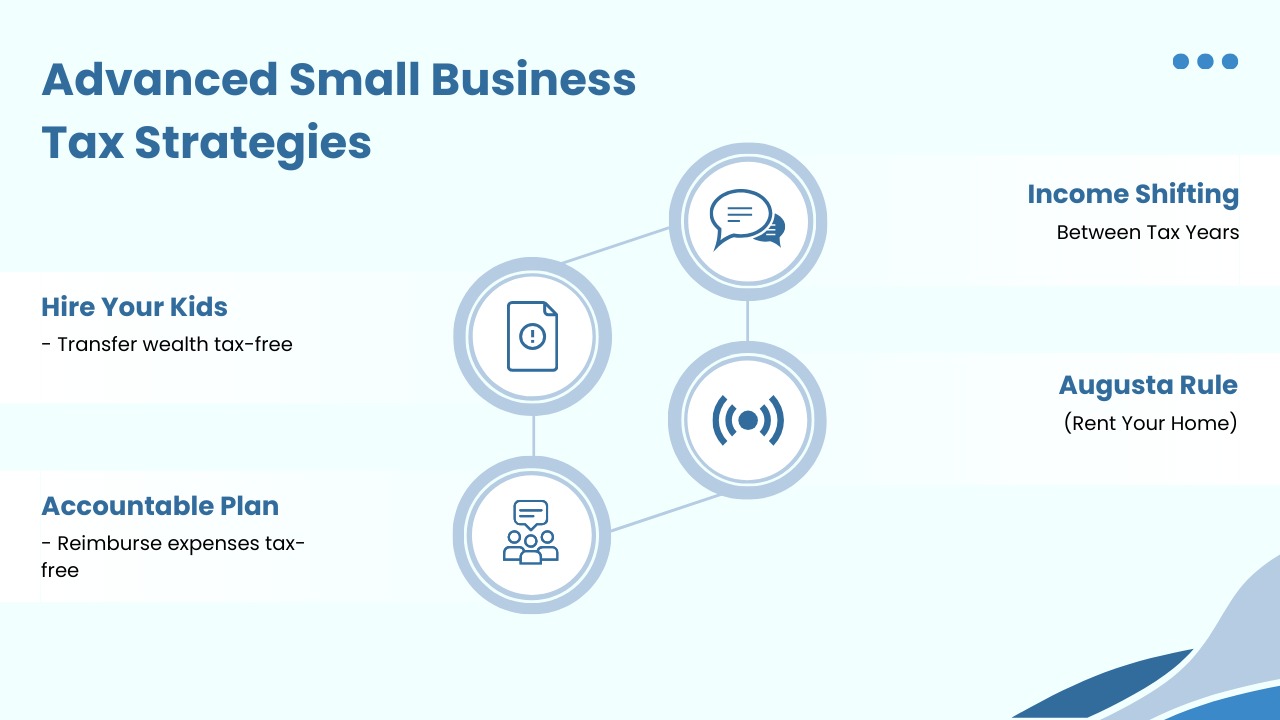
👨👧 1. Hire Your Kids — Transfer Wealth Tax-Free
Hiring your children (age 7–17) for legitimate business work provides multiple benefits:
- You deduct: Their wages as a business expense
- They pay: Little to no tax (standard deduction $14,600 in 2026)
- No payroll taxes: If under age 18 working for parent's sole proprietorship
- They can contribute: Up to $7,000 to a Roth IRA
Example: Pay your 16-year-old $12,000 for social media & admin work
- Your tax savings (24% bracket): $2,880
- Their tax: $0 (under standard deduction)
- They contribute $7,000 to Roth IRA
📋 2. Accountable Plan — Reimburse Expenses Tax-Free
An accountable plan allows you to reimburse employees (including yourself in a corporation) for business expenses without the reimbursement being taxable income.
Requirements:
- Expenses must be business-related
- Employee must substantiate expenses with receipts
- Employee must return excess reimbursements
What Can Be Reimbursed:
- Mileage ($0.70/mile in 2026)
- Business meals, travel expenses
- Home office expenses
- Cell phone (business use %)
📆 3. Income Shifting Between Tax Years
Cash-basis businesses can strategically time income and expenses:
To Reduce Current Year Taxes:
- Delay December invoicing until January
- Accelerate expenses (pay January bills in December)
- Make equipment purchases before year-end
- Prepay 2027 expenses in 2026 (if deductible)
To Increase Next Year Income (if expecting lower bracket):
- Invoice early in December
- Defer expenses to January
🏠 4. Augusta Rule — Rent Your Home Tax-Free
Section 280A allows you to rent your home to your business for up to 14 days per year TAX-FREE!
How It Works:
- Use your home for business meetings, conferences, retreats
- Charge fair market rental rate ($200–$1,000+ per day)
- Business deducts rental expense
- You don't report rental income (tax-free!)
Example: 10 Business Meetings at Your Home
- Charge: $500/day × 10 days = $5,000
- Business deducts: $5,000
- Tax savings (24% bracket): $1,200
- Your rental income: $5,000 tax-free
2026 Small Business Tax Checklist
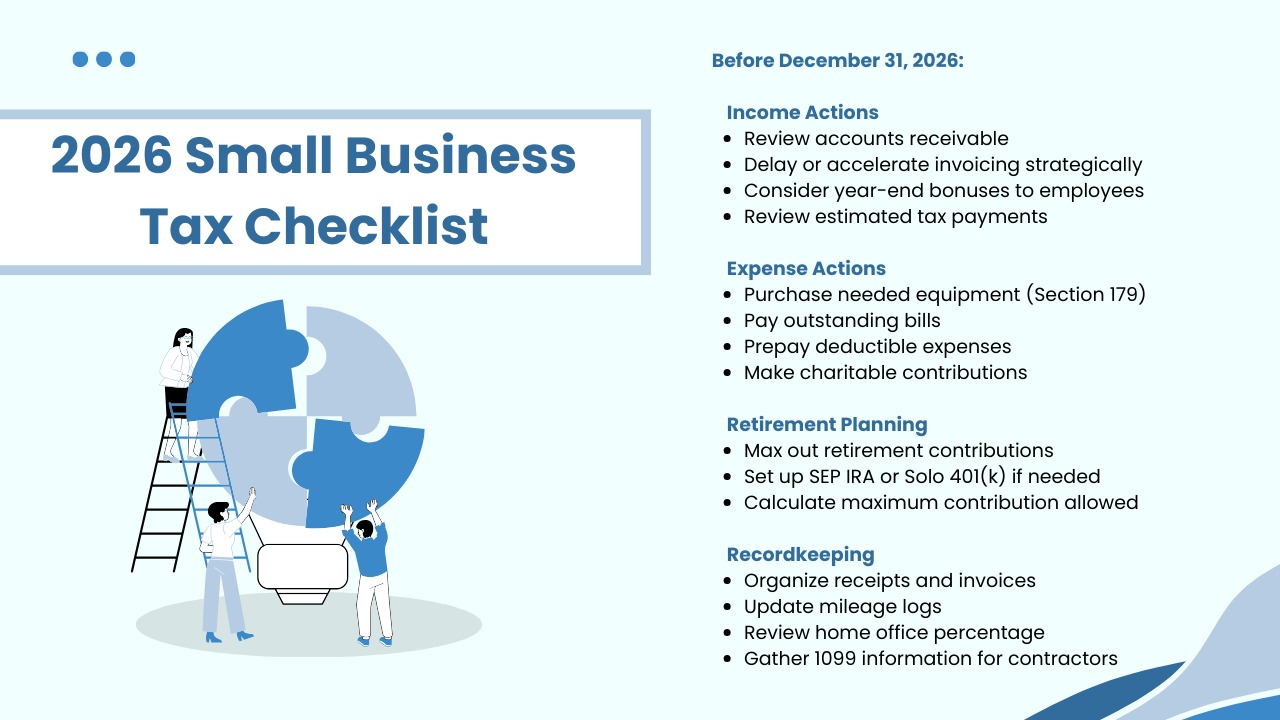
Before December 31, 2026 — complete these actions:
💰 Income Actions
- Review accounts receivable
- Delay or accelerate invoicing strategically
- Consider year-end bonuses to employees
- Review estimated tax payments
📦 Expense Actions
- Purchase needed equipment (Section 179)
- Pay outstanding bills
- Prepay deductible expenses
- Make charitable contributions
🏦 Retirement Planning
- Max out retirement contributions
- Set up SEP IRA or Solo 401(k) if needed
- Calculate maximum contribution allowed
🗂️ Recordkeeping
- Organize receipts and invoices
- Update mileage logs
- Review home office percentage
- Gather 1099 information for contractors
🧮 Ready to Calculate Your Business Taxes?
Use our free federal income tax calculator to estimate your 2026 tax liability and see how these deductions can save your business thousands.
Calculate Your Federal Taxes →