
Get Your Biggest Refund Yet
Did you know the average tax refund in 2025 is $3,011? Unfortunately, many people are throwing away their hard-earned money by not claiming all the tax credits and deductions they deserve. In this guide, we'll show you EVERY way to increase your 2026 tax refund, from the most overlooked tax credits and deductions to the most advanced strategies used by tax professionals.
- All 15+ tax credits you could qualify for and receive $500 to $7,430
- Above-the-line deductions to lower your AGI
- Itemized vs. standard deduction strategies
- How to adjust your withholdings for the largest possible refund
- How to time your taxes for the largest possible refund
- Common mistakes to avoid to increase your refund
BASICS
Credits vs. Deductions: What’s the Difference?
| 💰 Tax Credits (Better!) | 📉 Tax Deductions (Still Good) |
|---|---|
| A dollar-for-dollar reduction of tax owed Directly reduce your tax bill. A credit of $1,000 = tax savings of $1,000. |
Reduce your taxable income Reduce your income before taxes are applied. Depends on tax bracket. |
| Refundable credits: Can put money in your pocket even if you owe
$0. Non-refundable credits: Can reduce tax to $0, but no further. |
Deduction of $1,000 in a 22% tax bracket = tax savings of $220. Deduction of $1,000 in a 32% tax bracket = tax savings of $320. |
| Example: Child Tax Credit of $2,000 reduces tax bill by $2,000. | Example: Deduction of $10,000 = tax savings of $2,200 (22% bracket). |
💡 Priority: Credits First, Then Deductions
Tax credits are worth more than tax deductions. A $1,000 credit is worth exactly $1,000. A $1,000 deduction is only worth $220-$370, depending on your tax bracket.
 TAX CREDITS
Every Tax Credit You Might Qualify For (2026)
✅ Refundable Credits (Can Create Refund Even if Tax is $0)
Earned Income Tax Credit (EITC) - Up to $7,830
This is a refundable credit for low- to moderate-income workers.
| Children | Maximum Credit | Single Income Limit | Married Income Limit |
|---|---|---|---|
| 0 children | $632 | $18,591 | $25,511 |
| 1 child | $4,213 | $49,084 | $56,004 |
| 2 children | $6,960 | $55,768 | $62,688 |
| 3+ children | $7,830 | $59,899 | $66,819 |
- Have earned income (wages or self-employment income)
- Investment income under $11,600
- Valid Social Security Number for all family members
- Must file tax return (even if not required)
Child Tax Credit - Up to $2,000 per child
Up to $2,000 per qualifying child under 17 years old.
- $2,000 for each qualifying child under 17 years old as of the end of the year
- Up to $1,700 is refundable (Additional Child Tax Credit)
- Must have U.S. citizenship/nationality/resident alien status and SSN
Example: Family has 3 qualifying children. Total credit = $6,000. If tax liability is only $4,500, receive $1,500 refund.
American Opportunity Tax Credit (AOTC) - Up to $2,500
For the first 4 years of college.
Maximum: $2,500 per student (40% refundable: $1,000).
- Qualified expenses: Tuition, fees, required course materials. (Room & board NOT included)
- Requirements: Pursuing degree, enrolled half-time, no felony drug convictions.
- Phase-out: $80,000 to $90,000 (single) | $160,000 to $180,000 (married).
Premium Tax Credit (Health Insurance) - Varies
Helps pay for health insurance from the marketplace. Limits premium cost to a % of income and is fully refundable.
- Income between 100%-400% of federal poverty level ($15,060-$60,240 single / $31,200-$124,800 family of 4).
- No cap for those under 400% FPL (temporary).
- Cannot be offered affordable employer coverage.
- Potential credit: A family of 4 with income of $60,000 can save $10,000+ annually!
Other Nonrefundable Credits (5 - 8)
- 20% of first $10,000 in tuition/fees
- For any year of college or job skills courses
- Per tax return (not per student)
- Phase-out: $80K-$90K (single) / $160K-$180K (married)
- Up to 35% of $3,000 expenses (1 child) or $6,000 (2+)
- For care while you work
- Children under 13 or disabled dependents
- Phase-out: 35% down to 20% as income goes up
- 10%, 20%, or 50% of retirement contributions (max $2,000)
- For IRA, 401(k), 403(b), etc.
- Income limits: $38,250 (single) / $76,500 (married)
- Cannot be claimed by full-time students or dependents
- For qualified adoption expenses
- Per child adopted
- Phase-out: $252,150 - $292,150 (2026)
Energy Credits (Inflation Reduction Act)
Residential Clean Energy Credit - 30%
- 30% of cost for solar, geothermal, wind, fuel cells
- No dollar limit
- Carry forward unused credit
- Primary home AND second home
Example: Solar panel system cost $30,000 × 30% = $9,000 Credit!
Energy Efficient Home Improvement Credit - Up to $3,200/year
30% of cost with category limits:
- $1,200: Windows, doors, insulation, home audit
- $2,000: Heat pumps, heat pump water heaters, biomass stoves
- Must meet efficiency requirements
Example: $8,000 heat pump ($2,000 credit) + $4,000 windows ($1,200 credit) = $3,200 Total Credit/year!
Electric Vehicle Credits
- For new EVs or plug-in hybrids assembled in North America
- Battery component/mineral requirements
- Price limits: $80K (vans, SUVs, trucks), $55K (others)
- Income limits: $300K (married) / $225K (HOH) / $150K (single)
- Up to $4,000 or 30% of price (whichever is less) for used EVs at least 2 years old
- Price must be under $25,000
- Income limits: $150K (married) / $112.5K (HOH) / $75K (single)
- May only claim once every 3 years
Other Valuable Credits
- 13. Credit for the Elderly or Disabled ($3,750-$7,500): Age 65+ or permanently disabled with low income. Rarely claimed, but very valuable!
- 14. Foreign Tax Credit: Offset your U.S. tax liability for income from and taxes paid to foreign countries (alternative to Foreign Tax Deduction).
- 15. Work Opportunity Tax Credit (Up to $9,600): Business credit for employers who hire targeted groups like veterans or the long-term unemployed.
AGI DROPPERS
Above the Line Deductions (Reduces Your AGI)
These deductions reduce your Adjusted Gross Income (AGI), which directly lowers your tax bill and can help you qualify for the credits above!
| Deduction | Maximum/Limit | Requirements |
|---|---|---|
| Traditional IRA Contribution | $7,000 ($8,000 if 50+) | Income limits apply if covered by employer plan |
| Student Loan Interest | Up to $2,500 | Phase-out: $80K-$95K (single) / $165K-$195K (married) |
| HSA Contribution | $4,300 single / $8,550 family (+$1K if 55+) | Must have high-deductible health plan |
| Self-Employment Tax (50%) | 50% of SE tax | Automatically calculated |
| Self-Employed Health Insurance | 100% of premiums | Cannot exceed net self-employment income |
| SEP, SIMPLE, Qualified Plans | Up to $69,000 for SEP | Self-employed or small business |
| Alimony Paid | No limit | Only for divorces before 2019 |
| Educator Expenses | $300 | K-12 teachers and educators |
💡 Why Above-the-Line Deductions Are So Good:
- AGI Reduction: Less AGI means you qualify for more credits.
- No Itemizing Required: You can claim the standard deduction AND above-the-line deductions.
- Phase-out Reduction: Helps keep you below income limits for other tax breaks.
- State Taxes Reduced: Most states start with your Federal AGI.
DEDUCTION STRATEGY
Itemized Deductions vs. Standard Deduction
- Single: $14,600
- Married Filing Jointly: $29,200
- Head of Household: $21,900
You should ONLY itemize if your total itemized deductions exceed your standard deduction.
Main Itemized Deductions:
Qualifying expenses: Doctor/dentist visits, prescriptions, health insurance premiums (if not self-employed), equipment, mileage ($0.21/mile), long-term care.
Example: AGI = $80,000. 7.5% threshold = $6,000. Total Medical = $12,000. Deduction = $6,000.
Combined limit for State/local income taxes OR sales taxes, Property taxes (primary/secondary homes), and Personal property taxes (like cars).
Strategy: Deduct sales taxes instead of income taxes if you bought big-ticket items or live in a state with no income tax.
Interest on primary/secondary home mortgages, and acquisition debt (including refis, but not cash-out). Includes home equity loans if used for home improvement.
Example: $500,000 mortgage at 6.5%. Annual Interest = ~$32,000. Tax savings = $7,680 (in 24% bracket).
- Cash: Up to 60% of AGI (need receipts for $250+).
- Appreciated stock/property: Up to 30% of AGI. Deduct Fair Market Value and avoid capital gains tax!
- Bunching strategy: Combine 2-3 years of donations into one year to exceed the standard deduction threshold.
Only for Federally declared disasters (2026). Reduced by insurance reimbursement and $100 per event. Only the amount exceeding 10% of AGI is deductible.
PAYCHECK TACTICS
Adjust Withholding for a Bigger Refund
The amount of refund you will receive is simply the amount you overpaid during the year. You can have more tax withheld in each paycheck to guarantee a larger refund. It is like putting it in a savings account (though it is an interest-free loan to the IRS).
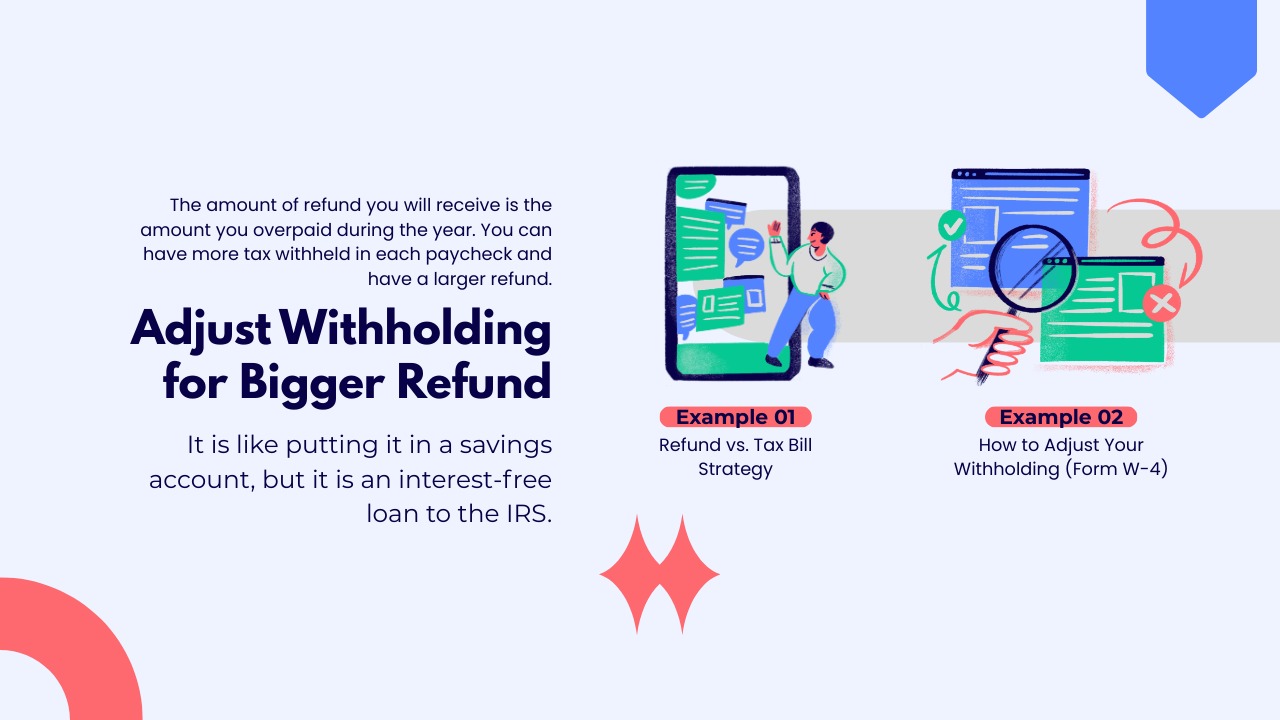
💰 Want a Bigger Refund?
Claim Fewer Allowances / Withhold Extra
💵 Want Bigger Paychecks?
Claim More Allowances / Withhold Less
Note: Tax professionals generally recommend minimizing refunds, but if you use a refund as forced savings, go for it!
Step-by-Step W-4 Adjustment:
- Step 1: Enter personal information
- Step 2: Multiple jobs/spouse works (use worksheet)
- Step 3 (Claim dependents): $2,000 per child, $500 per other dependent. Reduce this amount to increase your withholding/refund!
- Step 4a: Other income (increases withholding)
- Step 4b: Deductions (decreases withholding)
- Step 4c (EXTRA WITHHOLDING): This is the key to a bigger refund! Enter a dollar
amount per paycheck to have extra withheld.
Example: $50/paycheck × 26 paychecks = $1,300 extra refund!
TIMING IS EVERYTHING
Timing Strategies to Boost Your Refund
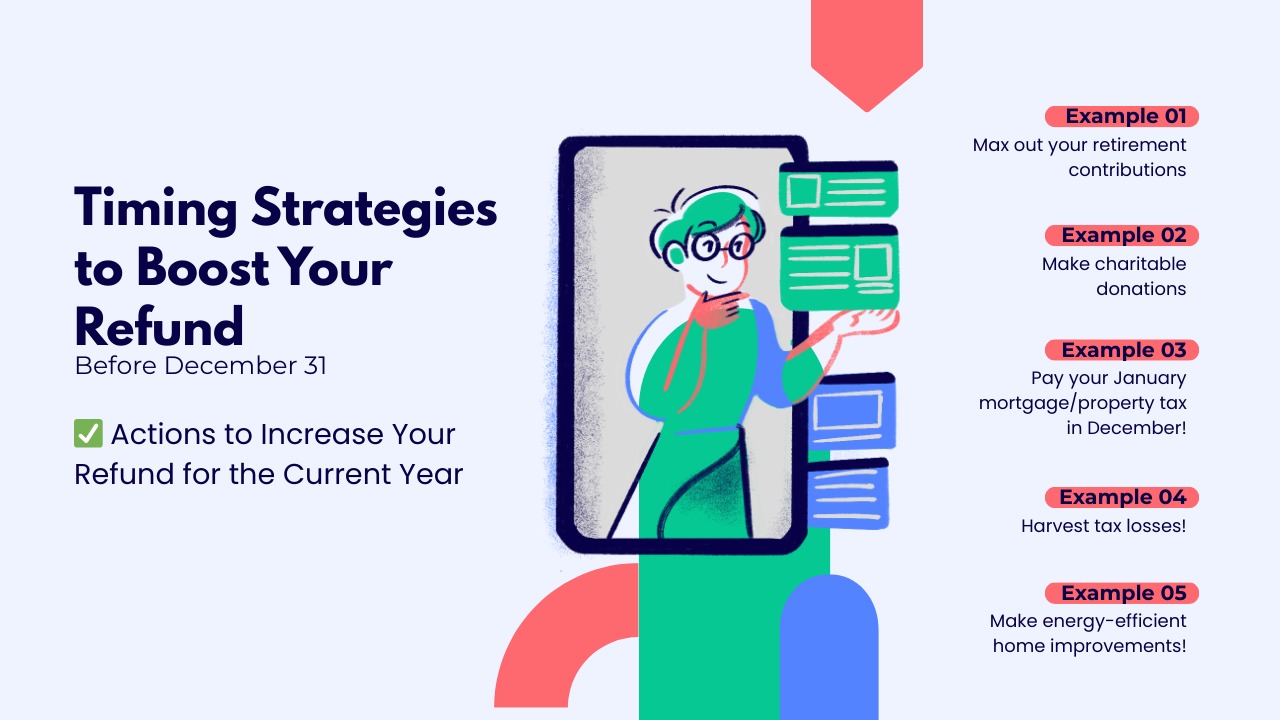
Before December 31:
✅ Actions to Increase Your Refund for the Current Year
- 1. Max out retirement contributions: 401(k) contributions must be made by Dec 31. Reduces income tax dollar-for-dollar!
- 2. Make charitable donations: Must be postmarked by Dec 31. Credit card donations work even if paid later.
- 3. Pre-pay January mortgage/property tax: Accelerate your deductions into the current year (only if itemizing).
- 4. Harvest tax losses: Sell losing investments to offset capital gains and up to $3,000 of ordinary income.
- 5. Energy-efficient home improvements: Must be installed and in service by Dec 31 for the 30% credit.
After December 31 (Until April 15):
📅 Actions for Your Prior Year Tax Return
- Contribute to your IRA: Can contribute until April 15 and designate for the prior year! A Traditional IRA reduces your prior year tax.
- Contribute to your HSA: Can contribute until April 15 to reduce your prior year income tax.
CHECKLIST
Your Maximum Refund Action Plan

❄️ January (NOW):
- Collect all tax documents (W-2, 1099, receipts, etc.)
- Consider prior-year IRA/HSA contributions
- Check off all credits & deductions you qualify for in this guide
- Use a Tax Calculator to estimate refund
⚡ February/March:
- File return as soon as all documents are available
- E-file + choose direct deposit for the fastest refund
- Consider professional help if your situation is complex
🔄 Year-Round:
- Keep track of all potential deductions and receipts
- Adjust W-4 if necessary for desired refund size
- Make estimated tax payments if self-employed
RESOURCES
Related Tax Resources
📊 Calculate Your Tax Refund Now
Stop guessing. Use our free, fast federal tax calculator to see your estimated refund instantly, based on the latest 2026 rates and rules.
Calculate Refund → Explore Tax Credits →